In praise of the sales colleague

My dear Sales colleague,
Now that the yearly sales closing is done, I am sure you would be experiencing a sense of great relief! Like the person gasping for air after having been forcefully thrust under water for a full three and a half minutes, this sense of freedom is unfathomable. A thousand kudos to you for withstanding the immense pressure of the 31st March deadline for achieving the annual sales target under which lesser humans would have easily succumbed. You have successfully managed to process the last minute orders, overcame debilitating internal challenges and ensured timely supplies… all these are nothing short of near super human feats that only a sales person like you could ever deliver!
A Sales person’s job is one of the hardest as it involves mastery over a range of hard and soft skills while the outcome is never certain. In a profession where you need to demonstrate unparalleled grit and determination just to stay afloat and relevant, it’s the great salesmanship in you that emerge triumphant. The communication and persuasive traits, that unique hallmark of a vintage salesman, is amply evident in the longevity of your career while your ability to empathise and evolve out-of-the-box solutions to customer demands is a trademark forte of a seasoned salesman. And when matters go wrong and bizarre and sales figures take a nosedive, it’s your resilience that stands you apart from the lesser mortals. You bounce back every time you are beaten, you adapt every time market conditions evolve and you call out every time internal systems become non-responsive! When success smiles, you take it in your stride knowing only too well that to continue in sales you cannot afford to rest on your laurels.
Yet it is always your job that is in the line of fire whenever figures slump even for reasons that are beyond your control. Though it is you who got in the revenue for the company for many years, helped it build the brand and identify new markets, it is always the sales man’s job that is at stake at the first whiff of adversity. The new product could be out of sync with market demands, the credit policies could be detrimental to sales growth and the problems of logistics and servicing could be appalling… yet none of them operating in these areas will be accountable for these lapses but only you, the sales person. While you are made to explain the downfall and risk job loss, others continue unaffected, even gain pay rises, promotions and possible retirement extensions and enjoy the unfettered security of a permanent job.
But as a Sales person you are only too aware of this anomaly and take it spiritedly as part of the job hazard and continue with your amazing work, smiling. For you too have a family to feed, a monthly home loan to pay, the children’s school fees to remit and elderly parents to take care of. You remain jovial and enterprising for you cannot afford to be otherwise, for the larger good. But let me assure you that the job you do is completely inimitable, most essential for the business enterprise and the value you bring to the table is indeed priceless. You are the jewel in the crown!
The month of March may have come and gone but as a true hero you continue to march valiantly, and unfazed!
Yours
Narayanan
A visit to a Puja Pandal
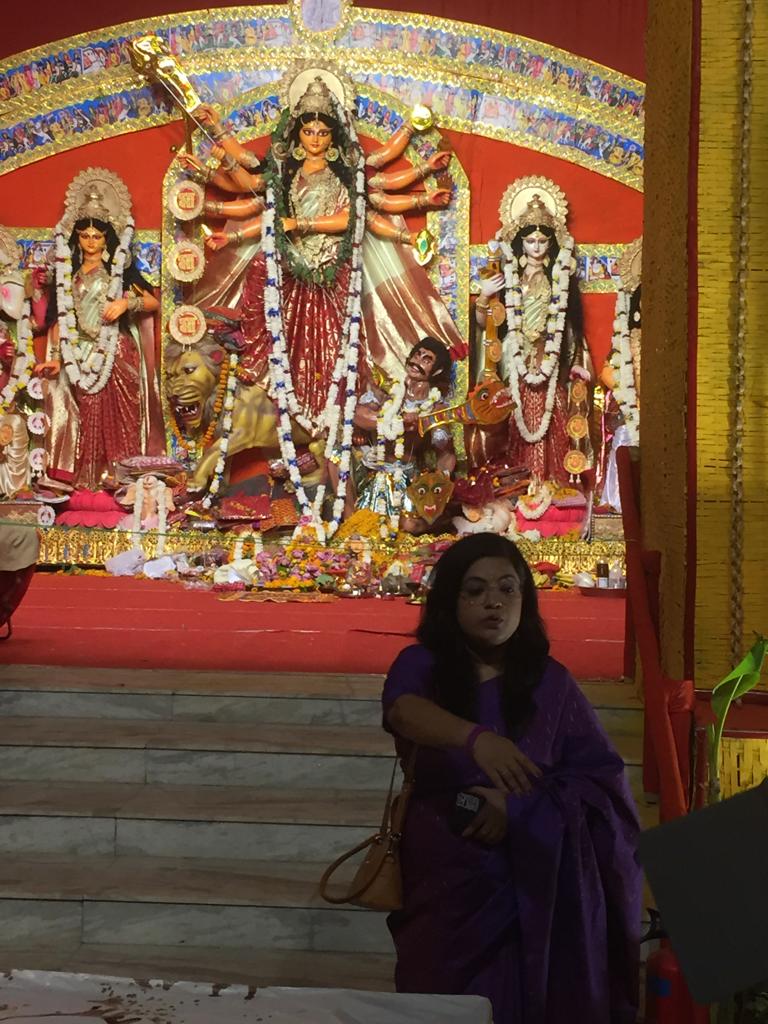
Draped in the finest silken attire and adorned with dazzling jewelry, the 15 foot high idol of Maa Durga with lethal weapons and piercing glance looks both enchanting and powerful. And when viewed through the misty fumes rising from the “Aartis” reverentially circled around her to the rhythmic beatings of the gongs and cymbals, she presents an awesome mystique of feminine divinity that transports the onlooker to a transcendental plane. The intensity of this elevating experience stayed with me long after I left the Pujo Pandal organised in our locality this Dussera.

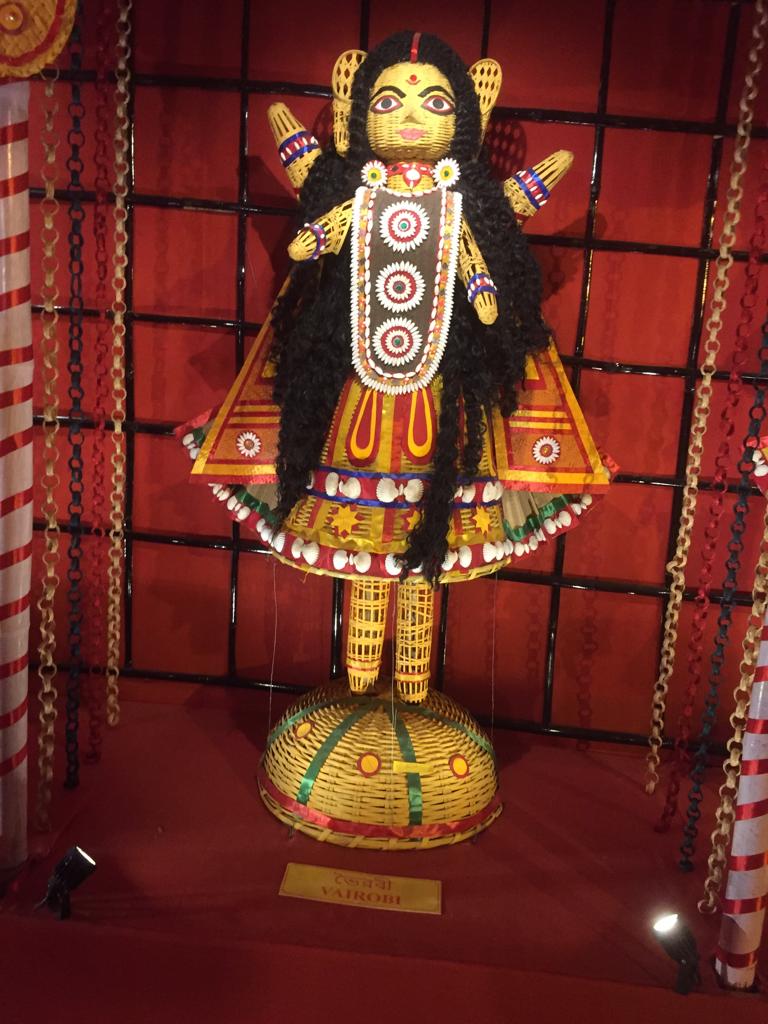
The Durga Puja Pandal organized every year by the Prantic Cultural Society is a religious, cultural and artistic extravaganza that showcases the rich tapestry of the Bengali culture spurn around the religious and devotional fervour of Navaratri. Along with the traditional pujas amidst chants and the rituals, the Pandal offers a wide variety of musical and dance events that is an audio-visual treat to the hundreds visiting the Pandal every day. It not only gives a kaleidoscopic view of the current Bengali cultural trends but also gives a stage for budding talents and aspiring performers. But the most striking aspect of this annual event is the construct of the Pandal itself, that is both a designer’s delight and an artist’s challenge. Always theme based, it gives expression, in solid forms, to the intricate imagination of a creative mind and embraces in itself the structure, the story and the message in an integral whole that leaves one visiting the Pandal spellbound. And it is the Handicrafts of Bengal that formed the theme of this year’s Pandal and it is a riot of colours and craftsmanship that is on display everywhere at the event.
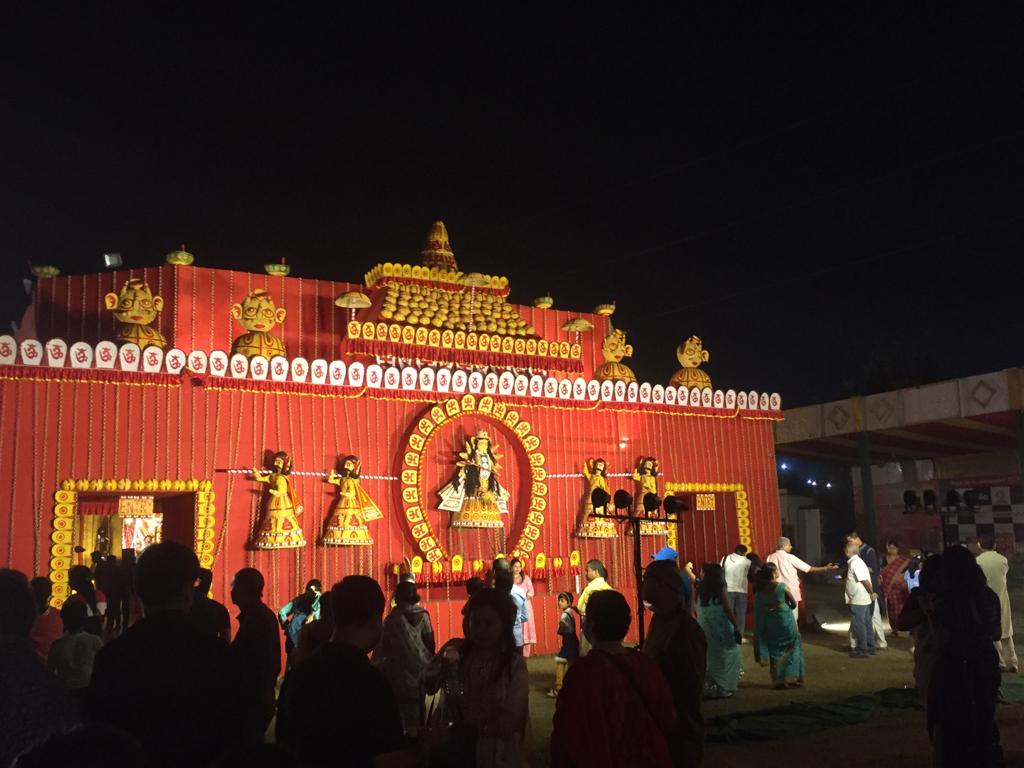
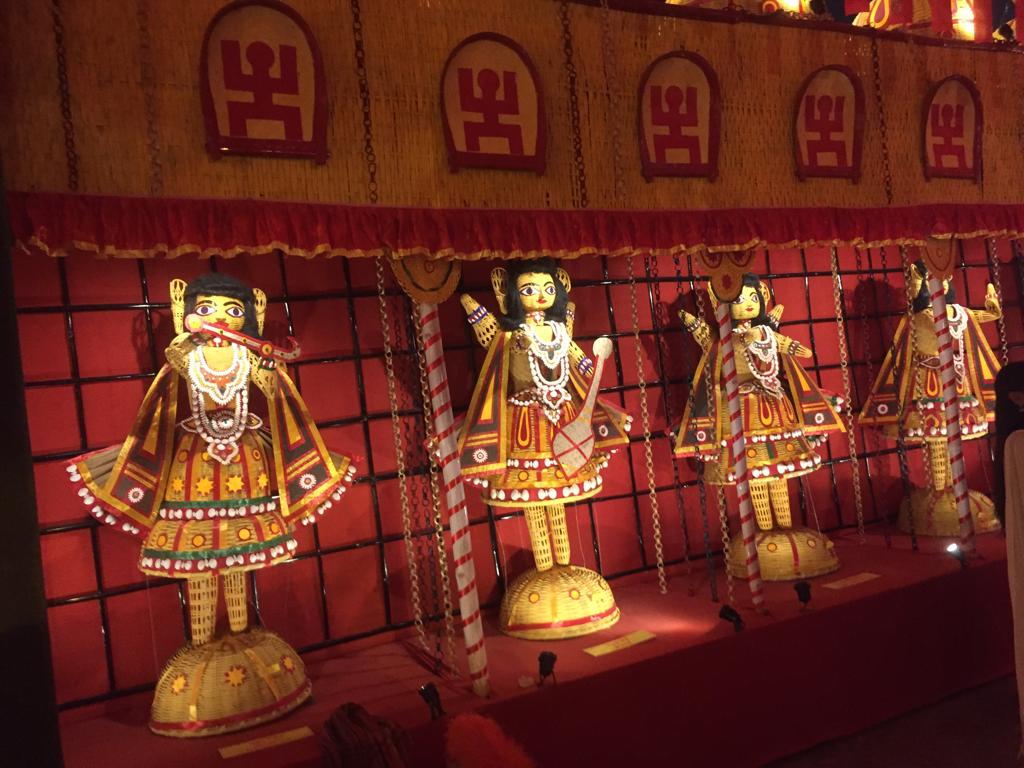
The entire display of theme is fashioned in Bamboo caskets that are richly embellished with sea shells, paper cuttings and other handicraft designs that bring into life myriad stories, from the yore to the epic. Be it the various forms of the Goddess that are crafted exquisitely in innumerable bamboo caskets in many sizes, shapes and designs or the picturisation of the ten forms of Vishnu detailing the characters of each Avathar, the thought and the effort that has gone into the making of each one of them is truly mindboggling! Add to that the external decoration of various themes in the form of arches, towers and reliefs, all in bamboo caskets, and you have an amazing display of craftsmanship in an expansive spread.
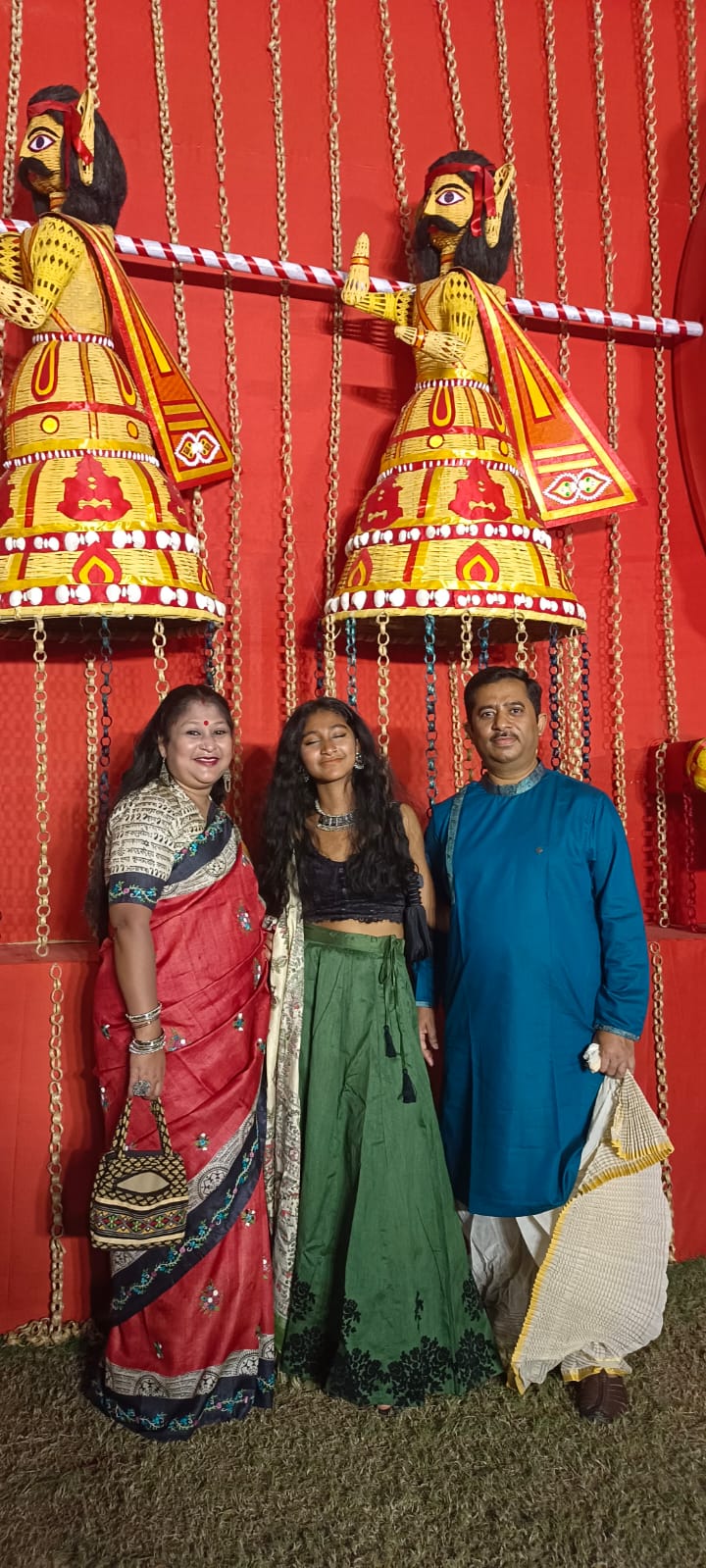
These structural magic on mere bamboos are erected by artisans from the East Midnapore of Bengal who have worked tirelessly, day and night, for over a month to bring into life a monumental expression of art. All the materials used for the construction were transported from Bengal to Delhi and meticulously crafted, piece by piece, at the venue site. They are then detailed and embellished with sophistication to breathe life to the hundreds of characters that are on display at the venue for the thousands visiting the Pandal to bask and marvel at the unparalleled artistry of these craftsmen! Their construct become mansions fit to be the abode of the Goddess while the artists themselves remain unknown!
Along with the beautiful handicraft structure of the site, the Pandal also is a foodie’s delight with a variety of cuisine on sale at its many counters. And as one relishes the delicacies of Bengal, the aroma of dosas and parathas emanate from other stalls. And if that is not enough to make a memorable evening, the traditional Bengali attires of many visitors are by themselves a treat to watch!
It’s the events like the Durga Puja that make us aware of the rich and diverse culture of our nation and as one learns more about the traditions, food, dress and way of life of others, the strands of nationhood is further strengthened!
Happy Durga Pujo!
Yours
Narayanan
The Chat and the ChatGPT
The panoramic scene of gusty winds, the grey overcast and the splash of slanting downpour on to the streets kicks off a mood, jubilant to enjoy the monsoon rains. Along with the urge to be tickled by the falling cool droplets on to the face, there is a craving in the palate these days to savour crispy and tangy snacks. Just when the season changes from heat and dust to wet and windy, as if possessed, there arise an uninhibited longing to indulge in adventurous gastronomical appeasement. I too fell a victim to this spell and decided to try dishing out a unique flavor of the season, all by myself! With scanty culinary experience and a big appetite, I could not possibly create any maverick dish without the assistance of an expert and I decided to seek one, from ChatGPT.

Me: It’s raining heavily and a good time to enjoy some great mouth-watering snacks. Could you suggest a few that can be prepared at home?
ChatGPT: Rainy days are indeed great time to enjoy some lip-smacking recipes. Here are a few from across the world that are easy to prepare that you may want to try:
- Mediterranean Hummus Bowl: It is a delightful combination of Chickpeas, quinoa, tomatoes, cucumbers, red onions, spinach, cheese and of course, hummus. It is colourful, healthy and makes a good snack.
- Arabic Sabboosa: is a great snack option that is both healthy and easy to make. This popular snack is made with simple ingredients – flour, sugar, and water – and fried in oil. The result is a golden brown.
- Chinese Dan-Dan noodles: A Sichuan noodle recipe that’s a one-two punch of umami with intense spice. This dish is known for its nutty, rich sauce and is made sesame paste, chili oil, and ground Sichuan peppers.
These are only a sample list of dishes you can quickly make and to provide you dishes with more specific ones, can you indicate your regional preferences?
Me: Hmmmm… I would like to try some Italian cuisine.
ChatGPT: Italian cuisine offers a wide range of delicious dishes. To provide you with the most popular ones, could you specify if you’re interested in vegetarian, meat-based or any sub-regional dishes?
Me: Vegetarian, of course!
ChatGPT: Italian cuisine offers a wide variety of delicious vegetarian dishes. Here are some popular Italian vegetarian recipes:
- Margherita Pizza: A classic Italian pizza topped with tomato sauce, fresh mozzarella cheese, basil leaves, and a drizzle of olive oil.
- Caprese Salad: A simple and refreshing salad made with fresh tomatoes, mozzarella cheese, basil leaves, and balsamic glaze.
- Eggplant Parmigiana: Layers of breaded and fried eggplant slices, marinara sauce, and melted cheese, baked to perfection.
- Risotto: Creamy rice dish cooked with vegetable broth and various ingredients such as mushrooms, asparagus, or saffron.
- Bruschetta: Toasted slices of Italian bread topped with diced tomatoes, garlic, basil, and a drizzle of olive oil.
These are just a few examples of the delicious vegetarian options that Italian cuisine has to offer. Whether you’re a vegetarian or just looking for flavorful meatless dishes, Italian cooking provides a fantastic array of options to explore.
Me: I am confused with such a wide variety….! What in your opinion would be an ideal one for me that is easy and quick to prepare?
ChatGPT: As an AI language model, my aim is to be as informative and objective as possible when providing responses to your queries and I do not have any personal opinions or beliefs. However, Caprese Salad is an Italian recipe that is easy and quick to prepare.
Me: What is the percentage of people who prepare Caprese Salad on a rainy day?
ChatGPT: I am sorry that I will not be able to provide that information. My knowledge is limited to the data as I was trained on up to September 2021, and I do not have the ability to browse the internet or access real-time information.
Me: Would you suggest Caprese Salad on a rainy day?
ChatGPT: While Caprese Salad is a delicious and refreshing dish, its suitability on a rainy day may depend on personal preferences. Some people enjoy light and fresh salads even on rainy days, while others might prefer warmer or comfort foods during such weather.
Food preferences are subjective, and there are no strict rules about what to eat on a rainy day. The most important thing is to choose a meal that brings you comfort and enjoyment, whether it’s a refreshing Caprese Salad or a warm and comforting dish.
Me: I get your point. What are the ingredients that go into the making of Caprese Salad?
ChatGPT: Caprese Salad is a classic Italian dish known for its simplicity and fresh flavors. The traditional ingredients of Caprese Salad include:
- Fresh Tomatoes: Use ripe, juicy, and flavorful tomatoes for the best results. Varieties like Roma or San Marzano work well.
- Fresh Mozzarella Cheese: Opt for high-quality fresh mozzarella, either in the form of small balls (bocconcini) or sliced.
- Fresh Basil Leaves: Use whole fresh basil leaves for their aromatic and herbal flavor.
- Extra Virgin Olive Oil: A drizzle of good-quality extra virgin olive oil enhances the salad’s taste and provides richness.
- Salt and Pepper: A pinch of salt and freshly ground black pepper bring out the flavors of the ingredients.
Me: But tomatoes are damn expansive these days and selling at Rs.250/- a kilo. Could you suggest a cheap alternative to tomatoes in Caprese Salad?
ChatGPT: Certainly! If tomatoes are expensive or not readily available, you can consider using an alternative to create a similar flavor profile in your Caprese Salad. One excellent alternative is to use juicy and ripe seasonal fruits that offer a sweet and tangy taste. Here are some options:
Fresh Peaches: Ripe and juicy peaches provide a delightful sweetness that pairs well with fresh mozzarella and basil.
Watermelon: Sweet and refreshing watermelon chunks add a unique twist to the traditional Caprese Salad.
Strawberries: Sliced strawberries offer a sweet and slightly tart flavor that complements the creaminess of mozzarella.
Me: All these are equally expensive….!
ChatGPT: If tomatoes and fruit alternatives are equally expensive or not accessible, you can explore some budget-friendly alternatives to create a similar salad experience. Here are some affordable options:
- Cucumbers: Sliced cucumbers provide a refreshing and crunchy base for the salad. They pair well with mozzarella and basil.
- Bell Peppers: Sliced bell peppers, especially the red and yellow ones, offer a sweet and colorful substitution for tomatoes.
- Radishes: Thinly sliced radishes add a peppery kick to the salad and add a nice crunch.
Me: This is getting too complicated….
ChatGPT: I apologize for the complexity. Let’s simplify it. If tomatoes and other alternatives are not suitable or affordable, you can stick to the basics of Caprese Salad with just two ingredients: fresh mozzarella cheese and basil leaves. This minimalist version still captures the essence of the classic dish and is delicious in its simplicity.
Me: I may have to leave this here as I am not sure I can prepare this recipe. Anyway, thanks for your input.
ChatGPT: You’re welcome! I understand, and there’s no need to worry. Cooking can be a fun and rewarding experience, but it’s also perfectly fine to take a break or explore other options.
If you have any other questions or need help with anything else, feel free to ask anytime. Take care, and have a great day!

Though frustrated with the fact that I was not getting any actionable suggestions from the AI model, I was equally determined to treat myself with some spicy snack, Indian if not Italian. And I waded through the muddy waters across the street to the road-side eatery to devour a plateful of soggy, crunchy and tangy Indian delight- Papdi Chat!
Yours
Narayanan
Disclaimer: This is a quasi-imaginary humorous chat meant to bring out the idiosyncrasies of the Al technology.
Kavad- A timeless Spiritual journey
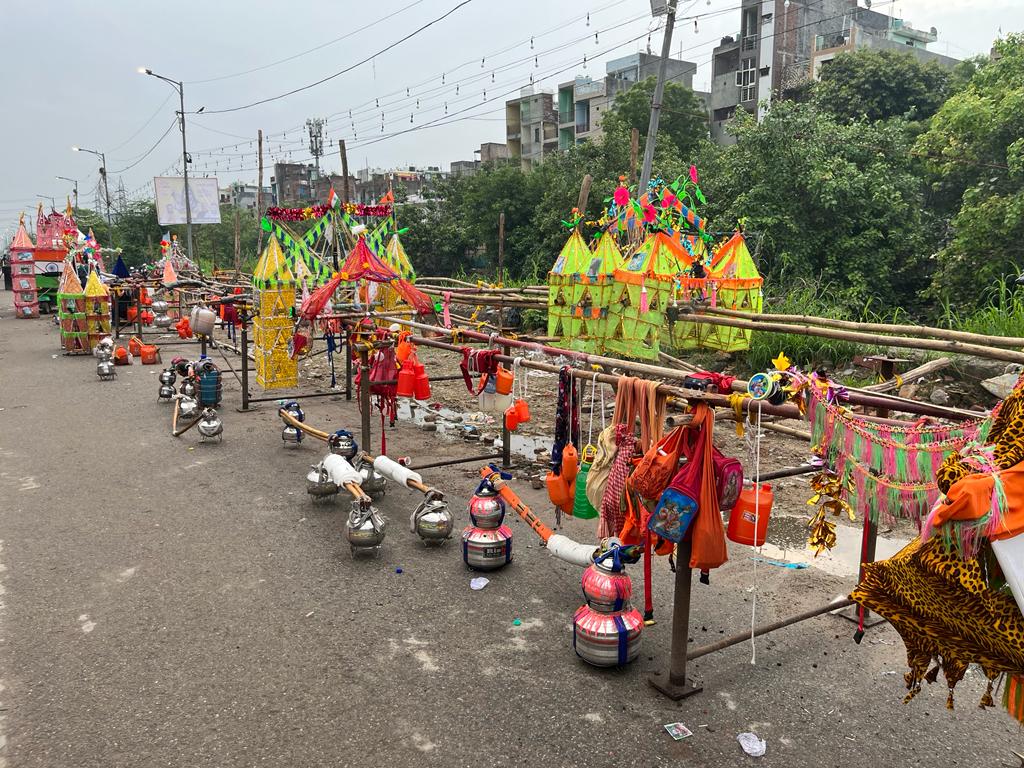
Chandan Sahu was trekking the two hundred fifty kilometre highway for the last five days, carrying on his shoulders a wooden framed colourful canopy, reverentially called the Kavad, balancing two heavy pots of water on both its sides. With brass belled anklets, Ghungrus, tied to his feet, every step Chandan takes sets off the multi hued Kavad to swing and sway rhythmically to the jingling of the anklets much like a peacock simmering its fanned feathers to the melodic tune gliding in the air. And when thousands of such Kavariyas like Chandan join in for the long march, it spreads a panoramic view of dancing colours up till the horizon which is both mesmerizing and spiritually enthralling.
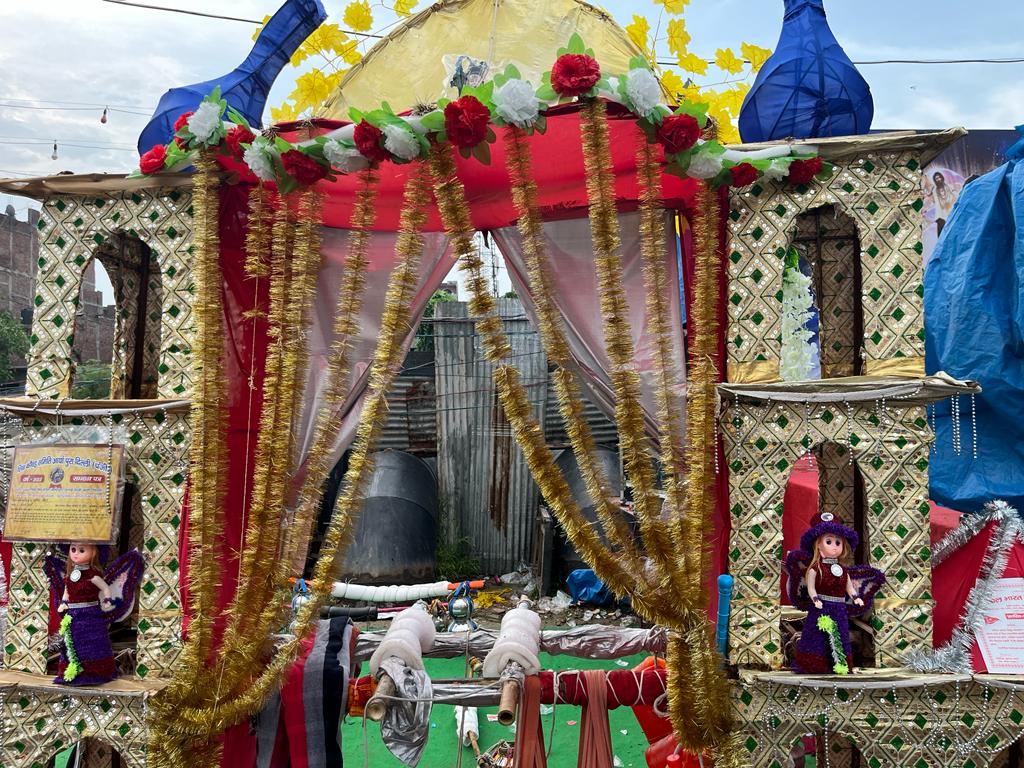
Kavad typically is a rectangular four feet high symmetric structure that is draped with decorative clothes and colourful festoons and tastefully painted with religious motifs and symbols on the sides. The two ends of the Kavad have tower like erections inside which are placed pots of water fetched from the holy river, Ganga. The wooden rod fixed across its centre allows the Kavad to sit easily on the shoulder of the Kavariya while he is on the move and it rests on the four stands when placed on the ground. And every year, for ten days during the month of July, tens of millions of devout Hindus carry, by foot, the Kavads on their shoulders from Haridwar, where the sacred river Ganga flows in copious abundance to their homes and villages hundreds of miles away. The holy water thus brought is offered for ablutions, Abhishek, to the local deities and is a ritual pregnant with spiritual significance. And as millions walk their way in sultry heat and dusty winds, what is in ample display is the manifestation of the eternal continuity of a vibrant civilization that carries its devotional tradition from the timeless past well into the future.
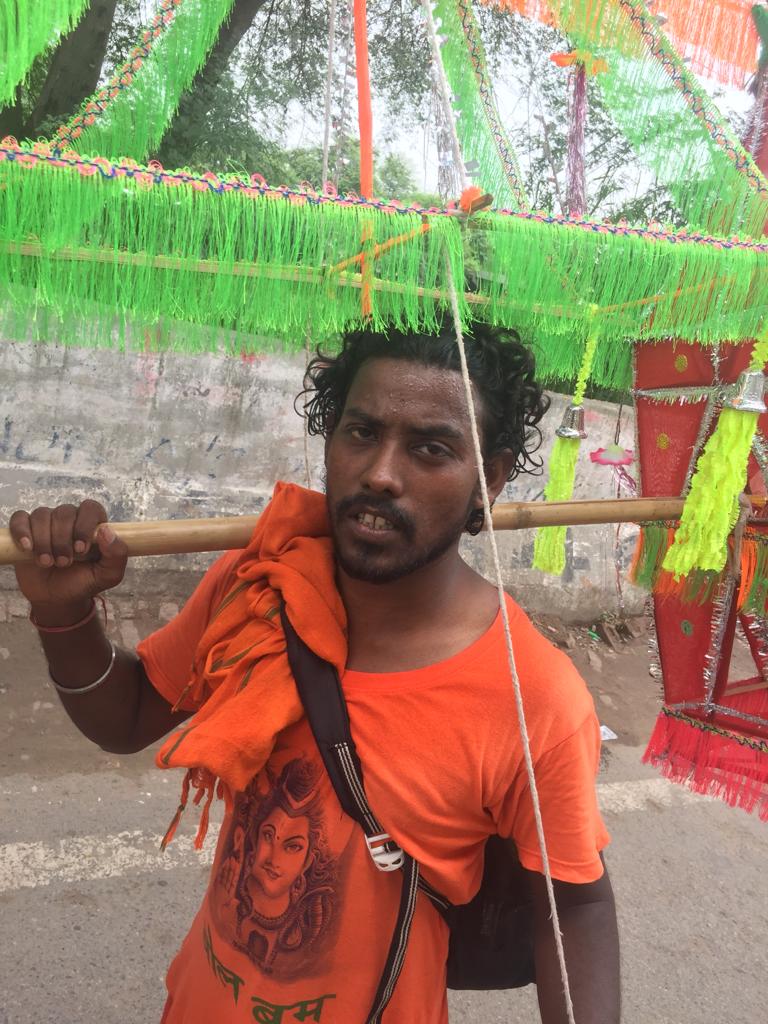
Chandan has undertaken this annual ritual for a couple of years now and it is his way of thanking the Lord for having blessed him with a son and a daughter. For he believes that without the divine providence, all human efforts would be a zero sum game and a life bereft of expressing gratitude to the compassionate Supreme would be a colossal waste. Both his feet are swollen with blisters as he barely limps along towards the last leg of the walk but the quiet radiance on his face signals immense fulfilment for accomplishing a deeply personal journey, one more time. And for Sharada Devi, this is the once a year opportunity to experience spiritual communion devoid of worldly distractions and as she completes the walk ten years in a row now, she only has thankful prayers to her God, Mahadev for choosing her for the arduous journey. For Chander, this annual pilgrimage is a way to rededicate himself to a life of austerity and self-enquiry.
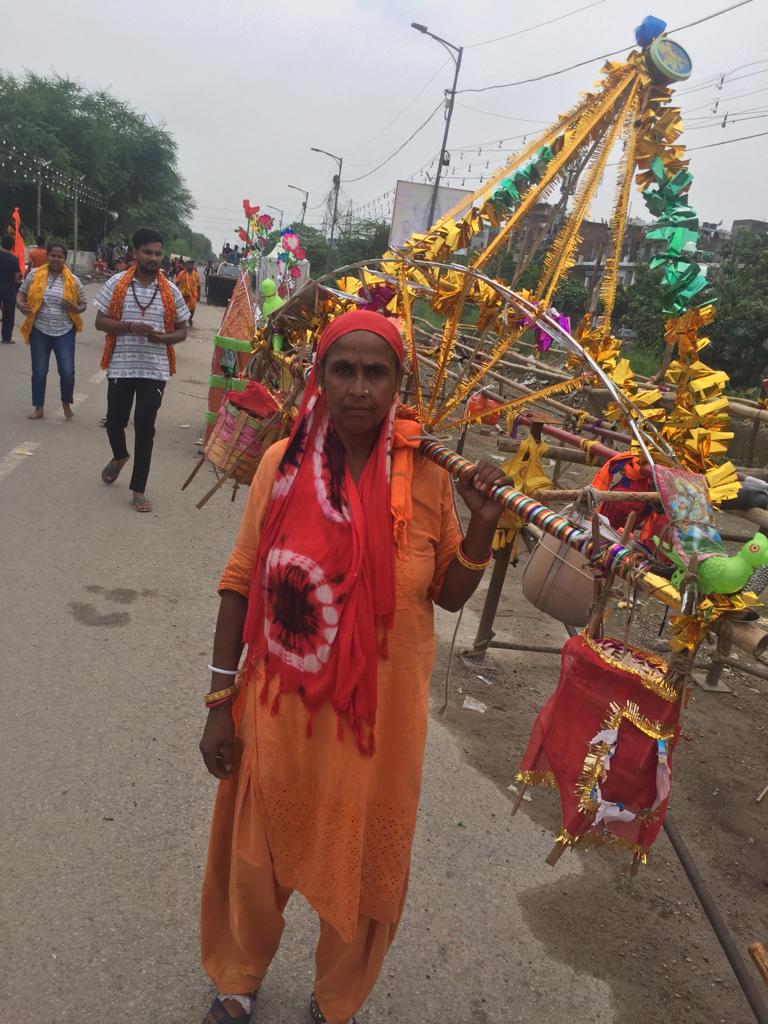
Though the initiative and desire to take the walk is purely personal, it is the support of the community that is critical to the successful completion of the journey. As the season of the Kavads begin, innumerable Shamiyanas spring up along the route that provide spaces to rest and re-coup and also offer food and medical services, absolutely free! Philanthropists and volunteers in their hundreds take it upon themselves the responsibility to ensure a safe and secure journey for the millions and it is indeed a lesson in brotherhood and comradeship to observe these men and women in action! Thus Kavad, in many ways, is a great social lever where the rich and the less fortunate, the learned and the illiterate, the sophisticated urbanite and the rural simpleton all lose their individual identity only to mingle into the one single confluence of the devotees of the Lord. Each address the other as Bhola, the innocent God, worthy of the highest reverence and respect and in that oneness of purpose to be the recipient of the divine grace, all man-made barriers that divide one from the other collapse and lose their relevance. Perhaps it is in this message of unity and equality, the Kavad owes it continuity through the millenniums.
And as the year’s Kavad Yatra comes to a close, there is a prayer and a promise in every Kavariyas heart to be again a part of this inexhaustible spiritual journey, next year!
Yours
Narayanan

Mother, it’s an honour to be your children!

While the loving care and the protective embrace of the mother is an absolute essential in the formative years for one to evolve as a well-rounded individual, it is indeed a celestial blessing to have her around till you are well past the mid-fifties. And providence has bestowed upon me such rarified privilege that her unconditional love has been the only one constant in a life that had its share of extended uncertainties and occasional turbulence. In the radiance of that elixir love, every problem of life, even of Himalayan proportion, would dissipate effortlessly just as the morning mist would, at the first rays of the Sun. From a subtle glance to a stern warning, a suggestive advice quoting religious parables or a timely moral reprimand that saves one from gross misconduct, the myriad forms in which her all encompassing love would manifest remained baffling but were always timely!

During the school days, when the focus was on living every moment with careless abandon, mother had been the anchor that allowed me have all the childhood indulgences even when my rebelliousness in school and outside remained a source of constant embarrassment for her. The class teacher would repeatedly ask mother to see her in school only to endlessly complain about my over performance in school antics along with the under performance in academics. When father would flatly refuse to affix his precious signature on my red mark laden report cards, it’s the mother who would sign on them unhesitatingly, masking her disappointment, coaxing me all the while to study and perform better the next time, every time! She would wait in the evenings with a ball of cotton and bottle of tincture to dress up the bruises that I invariably carry home from the playgrounds and the soiled uniforms will all be ready—washed, dried and pressed, the next morning! Those childhood times remain memorable to this day only because mother stood rock solid in the background guarding and guiding me at every little step.
When I moved to college, my priorities and thus the demands from the parents changed drastically and here again it’s the motherly care and affection that helped me sail through unscratched. While father would provide money just enough to pay the fees, it was mother’s kitchen savings that funded the growing expenses of the teenager that ranged from money for the movie tickets to that for purchasing the latest fad, the corduroy jeans. On every exam day, she would take bath in the wee morning hours and go to the nearby temple to perform a special pooja for my success while I would still be in deep sleep. I could safely vouch that my moderate academic achievement is more an answer to her fervent prayers than to my engagement with studies. This communion with the Gods she did for all her five children with demonstrable results and that it was not just limited for their academic success is a standing testimony for her deep faith and unshakable conviction on matters divine. When one of us fell sick, along with the rudimentary medicines, it’s the Vibhuti that she marked on our foreheads with a prayer on her lips that cured us all, almost instantaneously and without fail!

This motherly love that she radiated so copiously were not directed just to her biological children. Later on when I got married, mother’s compassionate gaze fell on my spouse too and in ample measure as she ably filled a deep void in my wife’s life when she lost her mother early on. She took upon herself as her motherly duty to provide care and succour that comes quite naturally to her and for her daughters-in-law, she was just their mother to whom they can confide their innermost fears and draw courage from. For her grandchildren, she was the granny that any teenager would long to have and in this age of instant gratification, she would give them lessons on patience and perseverance drawing instances from epics and provide unending solace as they dabble with the challenges of growing up in a super-connected world! In her, they found a glorious continuum from the priceless past where values are paramount and their adherence as critical as breath and love and compassion are the two eyes through which the world is to be viewed!
While she was so loving that took all in its embrace, she was also magnificently detached from the mundane affairs of the world. Resting in the confidence of the values she has instilled in her children, mother would not concern herself with their individual affairs. In the many years before the end of her life, she spent most of her time in spiritual contemplation and was in supreme peace with herself. This extolled state of existence is, for certain, a lesson for all of us as to how a contented and a purposeful life should be concluded.
Humble, gentle, graceful and always cheerful, mother was a role model for all of us as to how a daughter, daughter-in-law, wife, mother, mother-in-law and grandmother should conduct herself. And as she bids goodbye to us physically, I could only say that it’s a priceless honour to be born as her child, perhaps the reward for the meritorious deeds done over many past lives!
And my siblings: Rajaram, Sankar, Jayanthi and Soumya join me in expressing our immense gratitude to her for being our Mother!
Forever in gratitude
Narayanan
Seventy-five years of excellence… And counting!

The quest for excellence has remained the key factor that distinguishes the highly effective and successful organisations from that of the mundane. And for organisations driven by the ideals of excellence, success is neither a chance of circumstances nor an accident of fortune that happen in illogical regularity. For them, success is the cumulative result of a well-articulated vision, an organisational ethos that is people-centric and a dynamic yet an adaptive strategy that propel towards well-defined business goals– goals that are to be actualised on the bedrock of uncompromising principles. It is on these touchstones of excellence, Orient BlackSwan, a publishing company of unrivalled reputation, scores handsomely and hands-down! And as the company celebrates its seventy-five years of unparalleled service to the nation, it is only appropriate to investigate and dissect the key characteristics of this organisation that allows it to contribute so immensely for the purpose of education in the country.
Stephen Covey, the celebrated author, has identified seven cardinal habits that drive individuals and organisations towards excellence and it seems that is in the complete internalisation of these key traits that foster Orient BlackSwan to the iconic status that it enjoys in the industry today. Vouchsafed by many a renowned votaries of the Stephen Covey theory, practice and the assimilation of these habits come out of a deep conviction that long-lasting success is an extension of the ingrained values and principles and also that of the choices individuals and organisations make in their everyday transactions. And Orient BlackSwan, over the last seven decades and a half, has amply demonstrated its unwavering adherence to this time-tested traits that’s fit to be a case-study in the realm of business excellence.
At the time when the nation emerged from the shackles of the colonial rule, the Indian education was fully dependent on their erstwhile British masters, both for the framework of the educational system as well as for the content of the curriculum. The educational materials imported for the vast Indian student population were alien to the culture of the nation and there hardly were any textbooks published within the country. It’s in this scenario that Orient BlackSwan boldly ventured into a project of creating indigenous educational content that is firmly rooted in the Indian ethos to address the varied and unique needs of the Indian students. The organisation marshalled a battery of Indian authors and content creators, entrusted them with the freedom to experiment and innovate and the result were a slew of textbooks made in India, by Indians and for the Indian students. This pro-activeness is the one outstanding quality that distinguishes an organisation of vision from the one that’s focused solely on maximising profit through perpetuating the status-quo.
For Orient BlackSwan, the purpose of being in the publishing industry is to help create a strong and self-sustaining ecosystem that would impart high standard education for generations to come. While publishing quality textbooks is one part of this objective, the organisation relentlessly strives to empower teachers with the right training and focus on up-gradation of their skills so that the classroom transactions are as effective as the content. Orient BlackSwan is the pioneer in continuous teacher training programs in the country through which many thousands of teachers are enriched by this high impact training. Thus, a very clear grasp of the End in Mind towards creating an educated society is yet another trait that sets it apart from others in the industry.
The philosophy that the organisation upheld in all its activities is a lesson in itself for all businesses to emulate. The core values and principles are to be upheld under all circumstances and for Orient BlackSwan, these are non-negotiable. Even under the temptation of grabbing a huge business or in the face of losing a big order, the yardsticks for all dealings are always compliance to the ethical principles and no cost is too big to uphold the core values that the company cherish. This uncompromising adherence to Always Values First is indeed a rarity in current times when businesses largely run on values of convenience.

The collaborative nature of the company’s projects are so designed that all stake holders turn willing partners in the successful completion of them. The transparency, the free flow of communication and the adaption of feedback received across levels strengthen the sense of ownership and have a multiplier effect in the success of the all organisational endeavours. When tasks and its benefits are communicated effectively, a heightened degree of confidence is created across levels resulting in evolving a Win-Win culture and that’s what exactly Orient BlackSwan has mastered in creating, over and over again!
The effectiveness of an organisation is directly in proposition to its capacity to listen and assimilate market feedback and this trait is all the more crucial in today’s fast changing business scenarios. Be it in responding to the special needs of teachers to facilitate online classes during the Covid lockdown periods or in rolling out world-class digital products that are well integrated with traditional offerings, Orient BlackSwan has been a trendsetter, only to be imitated by others. This capacity to understand and to be understood by the market affords the company to effortlessly navigate the emerging ecosystem where blended learning would soon be the norm.
The diverse workforce, comprising of staff from every state, region and religion is yet another uniqueness of the organisation and the inclusive culture practiced at every level has stood the company in great stride. And this diversity is only matched by the even more diverse skill sets among the staff members which has unleashed enormous synergy across functions– from designing products to creating unique data management systems!
An organisation is only effective to the extent to which its staff members are happy and content and Orient BlackSwan has gone that extra mile to ensure overall wellbeing of its members. Be it in having a five-day work culture which is still a rarity in the industry or in envisioning a pension scheme much before it was even acknowledged by many organisations, Orient BlackSwan has always been a pioneer in devising myriad staff welfare programs. A case in point here is the compulsory paid annual leave travel to all the members! These are fashioned on account of the deeply held belief that only a well rested and rejuvenated workforce with opportunity to Sharpen the Saw of their skills can deliver to their fullest capacity.
It is a privilege to be associated with such an illustrious organisation and on this seventy-fifth year of its inception, we wish that Orient Blackswan continue to serve the nation and the cause of education for ages to come!
Yours
Narayanan.K
A staff member @ Orient BlackSwan.
Spotlight on Moonlight

His dad was never at home in the evenings and that’s the reason we friends usually hung out at Anil’s house unrestrained after our school hours. Being the father of four school going children and the only son to an ailing mother, his dad’s income from being an accountant was scarcely sufficient to pay both the rent for their house and put food onto the table. For fees and to buy uniforms for my friend and the siblings, he offered his expertise to put in place an accounting procedure at a booming yet highly unorganised vegetable shop that was located nearby. He would often spend long laborious hours in the shop making every entry of purchase from the scrapbook onto the ledger and faithfully register all the sales and expenses of the day to make financial sense of the shopkeeper’s daily dealings. Over a period of few months, my friend’s dad streamlined the myriad transactions into an intelligible financial document for the owner of the shop to instantaneously know how much he spent and earned on a weekly basis and how much more money he would need to set-up his next shop. The proprietor of the shop grew his business considerably within a couple of years, added three more outlets and had set up a centralised purchasing system. And all these were seamlessly integrated into a robust accounting platform that my friend’s dad had so meticulously created. And when the mega expansion plan to open a chain of vegetable shops in the towns nearby was ready, banks were queuing up to advance the money needed, by virtue of the strong financials and sound accounting practices the vegetable vendor has followed. For all his services, Anil’s dad was paid a princely sum of Rs.1500/- a month and a daily supply of vegetables to his house and both eased the pressure of the family’s budget.
And in another city, my uncle, a reputed musician working in the state radio station, would bicycle for miles everyday to conduct private music lessons to spruce up his income. He would wake up in the wee hours, quickly get ready and would set off to take multiple classes before he joined his official duty at 9 AM. The routine is repeated in the evenings and it would be well into night before he reached home. Though ostensibly my uncle’s private classes did make the financial condition of the family comfortable, he, in the bargain, had trained scores of students in the difficult skill of classical singing and on the way, produced a few outstanding musicians worthy of taking forward the legacy. Thus, his outside the regular job activities gave a great fillip to foster and nourish a precious art.
What Anil’s father and my uncle were indulging in is called Moonlighting, a perfectly accepted and even admired behaviour of responsible individuals to financially secure their families. And there are millions of such men and women who sacrifice rest and leisure and take up a second job so that the future of their dear ones are guaranteed. While many of them would be moonlighting to barely make the ends meet, a more aspirational lot have definite life goals motivating them to take up the second job. And whatever be the reason or the compulsion, it is in the nature of human beings to preserve and strive to prosper and moonlighting is indeed a legitimate method that turn one’s fortunes through hard work. And to call such a demonstrative life skill as unethical is completely misreading the instinctive nature of human preservation and a gross misjudgement of his priorities.
Moonlighting, along with being very useful to the individual, also contributes immensely to the development and maturing of the informal sectors. It is beyond the resources of many in the unorganised sector, like the vegetable vendor, to hire a full-time professional and moonlighting affords them with the skills and the expertise needed for their growth at a fraction of their original cost. An educational institution engaging a part-time professor, a management professional offering his services to a start-up company or a techie working in a reputed IT firm developing an App for a restaurant business are all helping the small businesses achieve traction at a low premium. If the reputed doctors were not moonlighting in smaller clinics and hospitals, our healthcare system would have been all the more fragile.
In a study conducted recently in the United States, it is found that many are postponing their retirement decisions due to financial compulsions and are, in fact, taking up multiple jobs to remain economically independent. So moonlighting far from being an Indian or an IT industry specific issue, is now a global phenomenon with technology making it more accessible at the individual level. And organisations making an issue about it are out of sync with the times we live in!
Yours
Narayanan
We The People: Seventy-five years of freedom

For the nation emerging from the shackles of a long and debilitating colonial rule and limping its feet in the sands of time that’s bloodied by a communal carnage of colossal magnitude, the Indian Constitution is the sanctified gospel crafted for a model nation state. Echoing the consecrated aspirations of almost a one-sixth of humanity, the Indian Constitution promises its people a life that is just, equitable, liberal and free from prejudice. With 395 articles spread over 22 parts, the Constitution of India is the largest written document for governance anywhere in the world. It has, among others, adopted features from the British, the American and the French constitutions and thus resonates the cherished values and principles that are universal, gained and refined through centuries of struggle.
Yet the guiding signposts for awarding ourselves with such an enlightened document, more so when the other country that simultaneously acquired independence opting for a highly sectarian and religiously bigoted statehood, are the timeless ethos of the Indian philosophical thought, enshrined in the Vedas and the Upanishads and etched deeply in the Indian psyche. The belief in the essential oneness of all human beings, in the idea that different sects are but limbs of the one Supreme Being formed the bedrock of an elevated idealism that translated into a workable political doctrine. And our constitution has stood our country in good stead!
The idea of equality of religions enshrined in it, for example, has its genesis in the Vedic dictum,” Ekam Sat, Vipra Bahudha Vadanti”, meaning, that “the truth is one and wise men describe it differently”. The acknowledgement of the fact that there could be multiple ways to inquire into the nature of truth, and that different religions are but varied pathways towards the same goal, paved to accept and integrate people of every religion into our mainstream politics. This principle afforded the state to treat every religion equally and confer equality to its practitioners, a salutary accomplishment that many nations still find hard to achieve.
Again, the concept of justice, of social, economic and political, has its underpinnings in the Upanishadic verse “Isavasyam idam sarvam”, meaning that the whole universe is permeated with one divinity and differential treatment of individuals is thus alien to our philosophy. This approach compelled the state to see poor and downtrodden as “ Daridra Narayanas” , worthy of special focus and targeted schemes to alleviate their poverty. At the social level, these “Harijans”, were seamlessly integrated through affirmative actions of the state, made possible only by the high ideals derived from our Vedic past.
The principle of fraternity that is embedded in the preamble of our constitution again can be traced to the Vedic roots which says : Saha Nau-Avatu, Saha Nau Bhunaktu Saha Viiryam Karavaavahai” meaning “May we protect us both together; may we nourish us both together; and May we work conjointly with great energy”. This idea of this kinship and camaraderie, so essential for nation building, has fuelled us to conquer newer heights in scientific and technological advancements and thereby help resolve many a teething problems of a young nation.
It could thus be established that it is the glorious Vedic school of thought that we have freely drawn from to frame our constitution that inspire and instil a sense of awe in every Indian. And it is in our collective responsibility to safeguard and nurture these fundamental ideals inherited from our aeonian past to strengthen the edifice for a glorious future.
And as we celebrate the seventy-five year of our Independence, the ” Azadi Ka Amrit Mahotsav”, we again turn to the Vedas and chant a prayer for the wellbeing and happiness of every Indian:
Sarve Bhavantu Sukhinah
Sarve Santu Nir-Aamayaah
Sarve Bhadraanni Pashyantu
Maa Kashcid-Duhkha-Bhaag-Bhavet
Which means,
May all become happy
May none fall ill |
May all see auspiciousness everywhere
May none ever feel sorrow |
May peace prevail ||
Yours
Narayanan
Chak De, Go for It!
“It would take three years to bring the learning standards of these kids to the pre-pandemic levels” laments the middle-school teacher as she abruptly stops explaining the concept of LCM and HCM to the non-responsive sixth grade class. Exasperated, she then resorts to writing down on the blackboard the step-by-step method of dividing a three digit number by a single digit one, the arithmetic that was taught to them three years back. If the children has lost the understanding of division during the long years of school closure, their lack of multiplication skills now also cannot be far behind. And the teacher, hence, decides to pull out exercises on rudimentary multiplication from the class three textbook for the students to complete them as homework!
The loss of learning for children in the absence of physical schooling was, till now, merely discussed among a few teachers and academicians, that too in passing and in lighter vein. But the scale and the magnitude of this education regression in India is dawning upon the nation only now, with the recent publication of the National Achievement Survey that poignantly captures the extent of the damage. In all the parameters of mathematical and language skills and in the conceptual understanding of environmental science on which the children were tested across the country, the exposed learning gap is astonishingly wide and disturbingly deep and is alarmingly way below the national average as recorded in the year 2017. This loss in learning is found even in states that are traditionally better off in school education and the rot seems to be spread nearly evenly across the nation with the surprising exception of Punjab and Rajasthan. Though both these states scored above the national average, it’s Punjab that tops the list, outdoing all other states in eleven of the fifteen subject areas that the children were assessed and also by bettering its previous performance of the year 2017 by miles!
This strikingly phenomenal performance of one state in education cannot have come without the underlying and compelling socio-economic conditions and it is not hard to seek those factors that play out in Punjab. The singular ambition of an overwhelming majority of the Punjabi young population today is to immigrate and study abroad and eventually settle there. And to secure an admission in universities located in countries like Canada, Australia or New Zealand an impressive academic record is an essential prerequisite. To add to that, a decent score in IELTS, that mandatory test in English language aptitude for university admissions abroad drives almost the entire young population in the state to take up their studies seriously, pandemic or no pandemic. This is vouched by the fact that when the entire nation is gripped by the onslaught of the Corona bringing to halt every activity, the number of students appearing for and clearing IELTS in Punjab did not abate. Thus ambition, when channelised at the right direction has the power to buck the negative trend and bring in impressive results which could turn out to be a role model and inspire others to emulate.

But mere ambition of the population to study well without a robust support system in place would just remain a pipe dream and it is here the role and commitment of the schools and the teaching fraternity of Punjab needs special mention. The state opened its schools last year much before the neighbouring states did and once the schools began functioning physically, the entire teaching community drew up a comprehensive plan to cover the lost syllabus. Many schools added extra days to the academic calendar and bridge programs initiated to do the catching up. The internet penetration being very extensive and the digital divide somewhat blurred in the state, the participation in online classes were much more in Punjab. With teachers enthusiastically lapping up the myriad digital tools available for teaching, the online classes proved decently effective in accomplishing the learning objectives and also did prevent any major slide back in retention. While all these may have also tried out in other states, it is the scale and the commitment of the vast majority of the stakeholders to roll out these initiatives that made the critical difference!

The findings of the National Assessment Survey though would be a shocker for many, also affords us the opportunity to approach the problem with a fresh perspective, and the experiment and success in Punjab could act as a guidepost in this effort. As suggested in another report, this time by the ADB, the learning loss if not corrected soon could adversely impact the GDP of the nation in the medium run. It is upon all associated with the school education to take note of the enormity of the task in hand to reverse the trend and there isn’t a day to delay this process. The need of the hour is to be on a mission mode and the time to act is NOW!
Chak De, which in Punjabi means “Go for It”!
Yours
Narayanan
Also read the story of a pizza delivery boy…. https://chapter18.wordpress.com/2021/08/01/a-pillion-ride-with-the-pizza-delivery-boy/
Musings from Kochi-III

If you were to Google for “the toughest Indian language”, the instant pop-up on the screen would invariably be Malayalam. With fifty-six letters and many ligatures (combination of two letters), Malayalam is easily the language with the largest number of alphabets and words formed with some of these are a near impossible for a non-native to pronounce. Try uttering ‘Mazha’(rain), that almost everyday weather occurrence in Kerala or ‘Thengya’ (coconut) that indispensable ingredient in every Malayali dish, you would get a sample of what a tongue-twister of a language Malayalam is! You might find ‘Elluppamaaya’ such a hard word to sound out, but it just means “easy’ in the language. And when hungry, you may want to say ‘Viśakkunnu’ signalling time for the meal but might end up uttering ‘Viyarkkunnu’ meaning that you are sweating profusely, a physical condition soon after having a sumptuous Malayali feast. But sweat you definitely will pronouncing ‘Vazhappazham‘, a gorgeous word for the humble banana while trying to utter ‘Khizhakku’, meaning east, your tongue might take a flight northwards. Your few brothers would collectively be called ‘Sahodarangal’ but each one needs to be addressed according to their order of precedence. Thus the one elder to you is a ‘Chettan’ and the other younger, a ‘Aniyen‘ though many refer to them as ‘Moothadu‘ and ‘Elayadu‘, meaning the matured and the tender. Overwhelmed by the burgeoning complexity of the language, you may just want to give up attempting to dabble with the tongue and might decide to say so in colloquial Malayalam…’Ennikku Vyya‘!
Yet it is the tough Malayalam which produces a vast body of literature across genres and the ratio of its readership to the native speakers is indeed the highest among all Indian languages. When the numbers of books published is very impressive, it is its circulation and the sheer volume of their sales that reflect the standing of Malayalam as a very vibrant literary language. This status is only further confirmed by the top of the chart readership for Malayalam newspapers and magazines among all regional languages and the trend shows no signs of abating even in the digital era. The literary movement is only strengthened by a strong network of libraries in Kerala, both small and big, that ensures deep penetration of all published works in the language. It’s no accident that the writers in the language have been the recipients of many prestigious international awards and of course, a large number of Gyanpeeth award winners are Malayalis!

Three distinct aspects can be discerned to have contributed to this pre-eminent status of Malayalam as a literary language par excellence. First, it is the religious literature of high poetical and philosophical merit produced in the language that contributed to it’s early growth. The ‘Adhyathma Ramayanam‘ by Thunchaththu Ezhuthachan written in a bird song format called the “Kilipattu” is considered a classic and continues to be a highly revered and narrated epic text. To that the works of sages like Poonthanam, inculcating a strong devotional fervour, popularised the poetic language among the masses. Also, the early translation of Bible, incidentally by two Hindus, Chathu Menon and Vaidyanatha Iyer, did further carry the written language to a wider audience. Second, the reform movements and the new political ideas that came from the West unleashed an epoch literary activity and an avalanche of classical works in the language came into existence. The contributions of the Great Trio – Kumaran Asan, Ullur Parameswara Iyer, and Vallathol Narayana Menon, gave the language a literary tradition and a modern outlook that helped it to absorb and assimilate fresh ideas. The later writers could build on this grand foundation and develop the language that’s capable of communicating highly complex social and political thoughts with ease. Third, Malayalam has been the language in which all the major international works got translated early on. Not merely of Marx, Tolstoy, Shakespeare or other internationally acclaimed writers but also the works of many lesser known African and Latin American authors were made available in Malayalam, enriching the literary pool and variety of the language. French novelist Patrick Modiano for instance, who won the Nobel Prize for his book, ‘In the cafe of the lost youth’ was translated into Malayalam six months before it was translated to English! About a hundred plus works in other languages are translated into Malayalam every year and there would hardly be a Nobel laureate in literature or a Booker prize winner whose work is not published in Malayalam!
And as the Malayali diaspora spreads its wings across the globe, the appetite for the language in its various literary and cultural forms is only bound to grow and thrive. So the next time you meet a Malayali, along with asking her ‘Nadu Evideyya’ do also check out ‘Enndha Vayikene?’ meaning “ What are you currently reading?”
Yours
Narayanan
Also read: https://chapter18.wordpress.com/2022/04/11/musings-from-kochi-1/
Musings from Kochi-II

Fourteen year old Stella is a very busy girl this summer. She gets up at 5.30 sharp, much before the sunrise, completes her morning chores in ten minutes flat and is at the dinning table, gulping down a glass of milk while her mother hurriedly plaits her curly hair tight. Quickly changing over to a trouser and the jersey T-shirt, she slips to her boots and by 5.45 is off to the grounds, with a full-sized football firmly secured in her bike carrier. Stella is damn serious about her training and is very ambitious of becoming a successful football player.

With more than three hundred children dribbling and kicking scores of footballs and a dozen of agile coaches constantly shouting and whistling, the Veli Grounds at Fort Kochi wears a festive and a noisy look every morning. The training, that ranges from physical exercises and stamina building to sharpening the myriad tactics of the game, is a complete program that would prepare talented players for further professional coaching and refinement. While Stella is busy playing as a forward in a friendly match on one end, a group of children are running around plastic cones placed evenly in rows in the middle of the ground to hone their agility and the reflex through zig-zag movements . And another set of aspirants are doing the rounds of reverse hopping over jumpers that strengthen their flexibility and the skills to quickly change directions while on the far end of the ground are a bunch of boys and girls practicing long and lofted shots to enhance precision with punch. In all these aspects, the committed coaches of the Veli Lions Football Academy, that organises the coaching, make sure that every child enrolled for the program go through a rigorous training in all aspects of game. The idea of the entire exercise seems to be to identify and catch the promising ones early and prepare them for the professional circuits while inculcating discipline and team spirit on all participants.

It’s said that if football were to be a religion, it would have the largest number of followers. An estimated 3 billion people around the world are active enthusiasts of the sport and hardly would there be a country where the sport is not followed religiously. And yet the popularity for the sport in a country of India’s size is rather minimal and the reasons for them is not hard to seek. With electronic gizmos and digital games taking central stage, the urge among children to go out in the open and play is fast dwindling. And it’s in the weaning away the young generation from the deliberating effects of the electronic games that organisations like the one in Kochi are to be appreciated and encouraged. In a country that is obsessed with Cricket, it is indeed heartening to see a bunch of highly enthusiastic youngsters taking up football as their passion and pursuing them with great vigour. And football teaches, along with building stamina and endurance, the ability to be focussed for extended duration, the art of teamwork and the essential social skills to relate and communicate, both with friends and strangers – all vital life skills in a highly integrated and digitalised world of the twenty-first century. And for the girls in Kochi to take up a predominantly male sport in such large numbers is particularly heartwarming and sends a very positive message of gender equality to the rest of the country.


As the world emerges out of the pandemic induced isolation for two long years, schools are struggling with the problems of reduced levels of concentration, shortened attention span, lack of discipline and obesity among students. These issues are apart form the more obvious and glaring problems of loss of learning of previous years and of lagging in academic targets. This changed scenario has thrown up fresh challenges for the schools to gear up the students to the earlier levels of competence and would need innovative methods and out of the box ideas to achieve them. And a training in the game of football with all its ingredients of physical exertion, stamina building and team coordination could become an important tool in rebooting the entire education system to pre-pandemic levels. Football, thus has the potential to become an integral part of the new age school program and it would be in the larger interest of the society to consider a game of soccer before the start of a school day.
Let the match begin!
Yours
Narayanan
Also read Musings from Kochi-1…https://chapter18.wordpress.com/2022/04/11/musings-from-kochi-1/
Fostering the Vedic lineage

The hazy sounds of the chorus Vedic chants heard from a good twenty meter distance turns electrifying as one steps into the sacred precinct of the Sri Bharathi Theertha Veda Patasala, situated in Mattancherry, Kochi. The rhythmic intonations of complex Vedic mantras by a group of dhoti clad boys sitting cross-legged in two inner-facing rows transports the listener to a rarefied field of divine exuberance. The benign glance of Seetharama Ganapadigal, sitting imposingly at the centre with hands gesturing the ebb and flow of the verses, ensures a strict discipline to the oral academic tradition and brings to life the extolled Guru-Shishya Parampara. And as the students effortlessly chant pristine sanskrit verses in precious meter and with clear diction, one is overwhelmed at the expanse of the Vedic knowledge and the grandeur of its expression!

The Patasala stands as a powerful beacon of light in the dissemination and in the re-establishment of the glorious Vedic wisdom and the students graduating from its portal spread far and wide to foster further this ancient tradition of learning. The pupils go through an exacting daily routine to grasp the essence of the vedas and to master the technique of its correct rendition for a period of ten long years. The daily schedule of a Shishya starts at the wee hours of the morning and the entire day is strictly regimented into vigorous periods for learning, practice, meditation and reflection. In the course of the curriculum, a student is expected to master 3500 Vedic verses called the ‘Suktas’, understand and grasp its philosophical underpinnings and chant them in different formats, each style more complex than the preceding one. The student once well versed in ‘Moolam’, the basic format of chanting is led to the advanced ‘Padam’ rendition and further progresses to more complicated and nuanced styles of ‘Kramam’, ‘Jadai’ and ‘Ganam’. And the mastering of such a vast body of knowledge and the formats demand an intellect of a superior order, a razor sharp memory and a voice quality that booms and reverberates. The student passing out is also a well disciplined individual with deeply engrained high moral and ethical values… a harmonious synthesis of the qualities of the head and the heart.

Vedas are the divine revelations, the Shruthi, and are the life breath of the Bharatiya culture. Sages of the yore to whom these sacred knowledge were revealed, codified and broadly classified them into four distinct branches – The Rig, Yajur, Sama and Atharva Vedas with each of these further sub-divided into Samhitas ( hymns), Brahmanas (rituals), Aranyakas (theologies) and the Upanishads, the philosophical thought pertaining to the branch. The Upanishads, also called the Vedanta, seeks to explore the nature of the Brahman, the Supreme, and establishes the truth, through dialectical reasoning, the oneness of all creations. Orally passed on from generation to generation, these vast compilation of texts covers all aspects of human knowledge and addresses myriad human needs, progressively leading the learner to the ultimate truth. Thus the Vedas can be unequivocally proclaimed as the texts of the supreme truth on which the entire edifice of the Sanathana Dharma, the eternal religion, stands erected and is the bedrock of the Bharatiya Sanskriti, the Indian culture, thought and civilisation.

And the torchbearers of this ancient wisdom has been the Brahmins, the priestly class, who, through their dedicated and selfless commitments, have successfully preserved these priceless heritage over millenniums. Undertaking many a personal sacrifice, withstanding immense challenges over centuries and many living in abject penury, Brahmins have gloriously upheld the sacred task of protecting and fostering the Vedas and securing them for the future generations. Harnessing modern communication tools, select members of the community are still immersed in the propagation of the Vedas and personages like Seetharama Ganapadigal are an integral part of that unbroken lineage established by the sage Vyasa Krishna Dwaipayana.
Bhartiya culture will be preserved, protected and fostered only if the Vedic traditions are propagated and nourished and the true identity of the nation rests in the internalising the universal ideals as declared in the Vedas.
“ Lokah Samastah Sukhino Bhavantu”, meaning, ‘May the entire world be happy’!.
Yours
Narayanan
The structure of Vedas

Musings from Kochi-1

The catamaran with the outboard engine cruised elegantly towards the silvery sands of the Fort Kochi beach. And just as it neared the shallow waters, Martin switched off the propulsion system allowing the boat to lazily drift towards the land. Once slowed down, Joby, Sunny, Jackson and Xavier jumped off the catamaran, each carrying a log of solid wood and hastily spread them parallel on the ground, at an equidistance of about a meter apart. Martin navigated the boat over the sleeper woods and brought the boat to a majestic halt making the transition, from the high seas to the safe shores, a perfect one!
The five fishermen had ventured into the seas the previous night and after repeatedly spreading the net for a gruelling twelve hours, the catch for the day was just lacklustre. Mackerel, or Aiyla in Malayalam, is the only variety that were caught and with all of them to share the bounty equally, it is another day of disappointment for them. The hotel and tourism industry in the city is yet to recover from the pandemic shock and with the season of Ramadan now on, the demand for the fishes is at its nadir, pulling down the prices to its lowest level. And a bucketful of Mackerel would hardly fetch enough money for the five of them to buy some food for the family and also pay for the diesel to make the next trip to the sea. The hard life of these fishermen only just got worse!
The picture of a lonely man casting his net from his small boat has been on the covers of many a glossy tourism magazine but the entire ecosystem of the fishing industry is so stacked against the small fisherman that his life is anything but glossy. Big trawlers go deep into the high seas and remain floating for weeks on end affording them with huge catches of a variety of marine lives. And the purse-seine method they adopt allows no creature that it surrounds to escape leaving very little for small fishermen with conventional nets to bank on. The catches are stored in gigantic freezers in the trawlers themselves that ensure intense fishing and zero wastage while small boats need to make shorter and more frequent trips back and forth for want of cold storage facility. Once on the shores, they are forced to sell the fishes quickly as they need money to make the next trip compromising on the price front and this cycle of exploitation goes on and on.

This assault on the small players is universal and cuts across industries, professions and trades. Small shop-keepers are at a huge disadvantage vis-a-vis big marts and online giants, small farmers, pitted against corporate farming, are on perpetual survival mode and small manufacturers, faced with the relentless onslaught of technologically superior big sharks, are on compulsive sustenance level. Small, once considered beautiful, looks increasingly ugly!
But it is the small and informal operations that provide the largest number of jobs and is the backbone of a developing economy like that of India. And if the small ceases to exist, the big would also be in jeopardy as the demand for their product is created by the wealth generated by the small. For this cycle to sustain and flourish, there needs to be a conscious effort to strengthen the small and integrate it with the large and make the system a composite whole.
Meanwhile, Jackson has promised his family a lavish Easter feast complete with mutton and a bottle of wine but with his daily catch going down along with its price, he is worried whether he could fulfil his commitment. With just four days to go, he still is an optimistic man!
May the Lord fulfil his small desire. Amen!
Yours
Narayanan
Also read Kochi shows the way… https://chapter18.wordpress.com/2022/04/21/musings-from-kochi-ii/
Holi-The wellspring of joy

The golden sun beam piercing the morning haze spreads a cosy warmth on the pristine earth. The gentle northerly breeze wafts the fragrance of a thousand flowers as its countless hues carpet the ground till the horizons. The sweet chirping of the cuckoo birds strike a lingering melodious note of a bygone era. And the scented countryside is bustling with the harvest of many a bountiful crop spilling the granaries with lustrous grains. The days are getting longer and brighter and it’s that time of the year when nature decks up to unravel her beauty, most grandeur! Rejoice, the celestial season of Basant, the Spring, is here yet again, filling every heart with unfathomable joy and glorious bliss!
The season of Basant also enlivens the mystical and divine romance, enacted by the Lord, through colourful dance set to rapturous music. The Rasa Leela captures the myriad shades of love that the Gopis nurtured towards their beloved and the pangs and agonies caused by their separation from him, that invariably follow. They long to hold the Lord closest to their hearts but the playful One gives them a slip, everytime And Radha embodies the eternal quest for that nectarine sweetness of supreme love and the human predicament that prevents the final merger. Basant, in many ways, is also a celebration of unadulterated love, victorious of its many trials, victorious of, to borrow a phrase, the “Ishaq Ka Imtihan”.
The natural adjunct to the season of colours is the festival of colours, the “Holi”. With a riot of dazzling shades, deafening music and unrestrained revelry, Holi is one occasion when man lets go his self-imposed importance and indulges in joyful inter-mingling without inhibitions. The colour on the faces is a great leveller that erases the distinction between the boss and the subordinate, between the ruler and the ruled, and, between the prosperous and the dispossessed. And herein lay the egalitarian message of the festival and its loud affirmation on the essential and underlying unity of all creations that is beyond the multiplicity of the manifested world.
Oh, what a season, what an occasion, what a festival and what a message…. I am getting my “Pichkari” ready, what about you?
Yours
Narayanan
At the Dargah
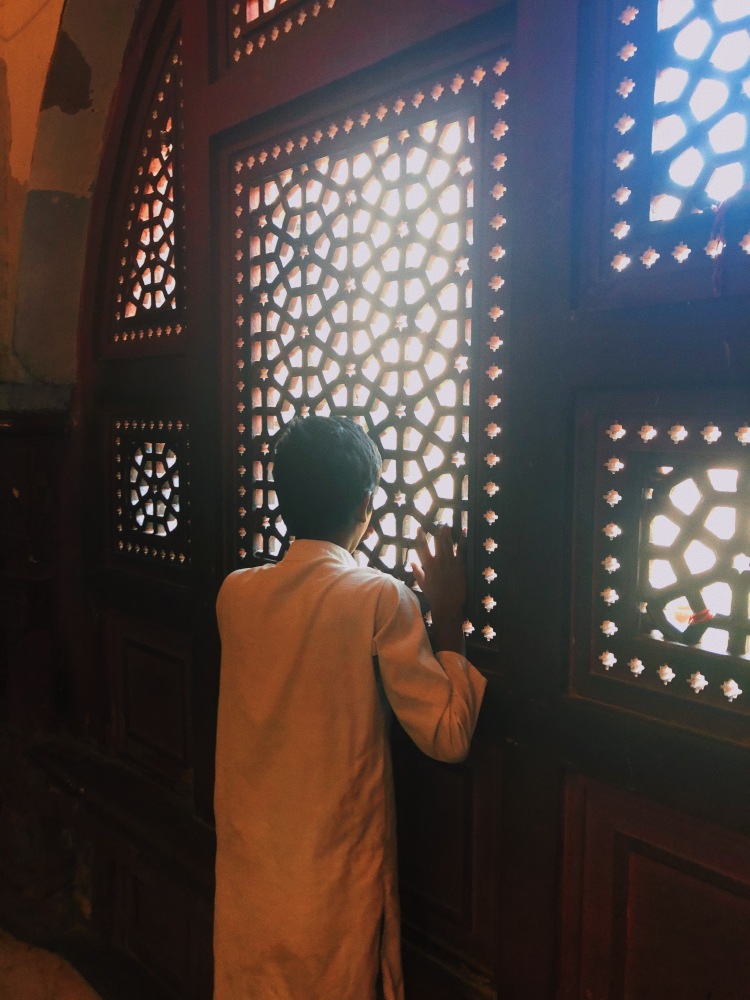
My daughter has started a new photo blog and am sharing it here!

Met this sweet boy at the Nizamuddin Dargah during Eid. He was looking over at the Baoli. To me this picture represents a pure moment of faith and innocence.
 chapter18
Recent comments